A router that actually forwards
One OpenAI-compatible endpoint for all your apps. AgentLedger picks the model, forwards the call — streaming included — and writes the measurement while doing so. Not a meter next to a proxy: the same movement.
AgentLedger sits between your apps and the models. It picks the cheapest suitable model per task, actually forwards the call, and writes down what happened along the way: which route, which backend really executed it, how many tokens, what it cost — and when it does not know for sure. A meter next to a proxy is always one step behind the facts; this is the same movement.
The app talks to a single endpoint. Behind it the source is recognised, that source's policy applied, the call forwarded to the chosen backend and the result written down — including what the backend itself chose, because that is rarely the same as what was asked for.
One OpenAI-compatible endpoint for all your apps. AgentLedger picks the model, forwards the call — streaming included — and writes the measurement while doing so. Not a meter next to a proxy: the same movement.
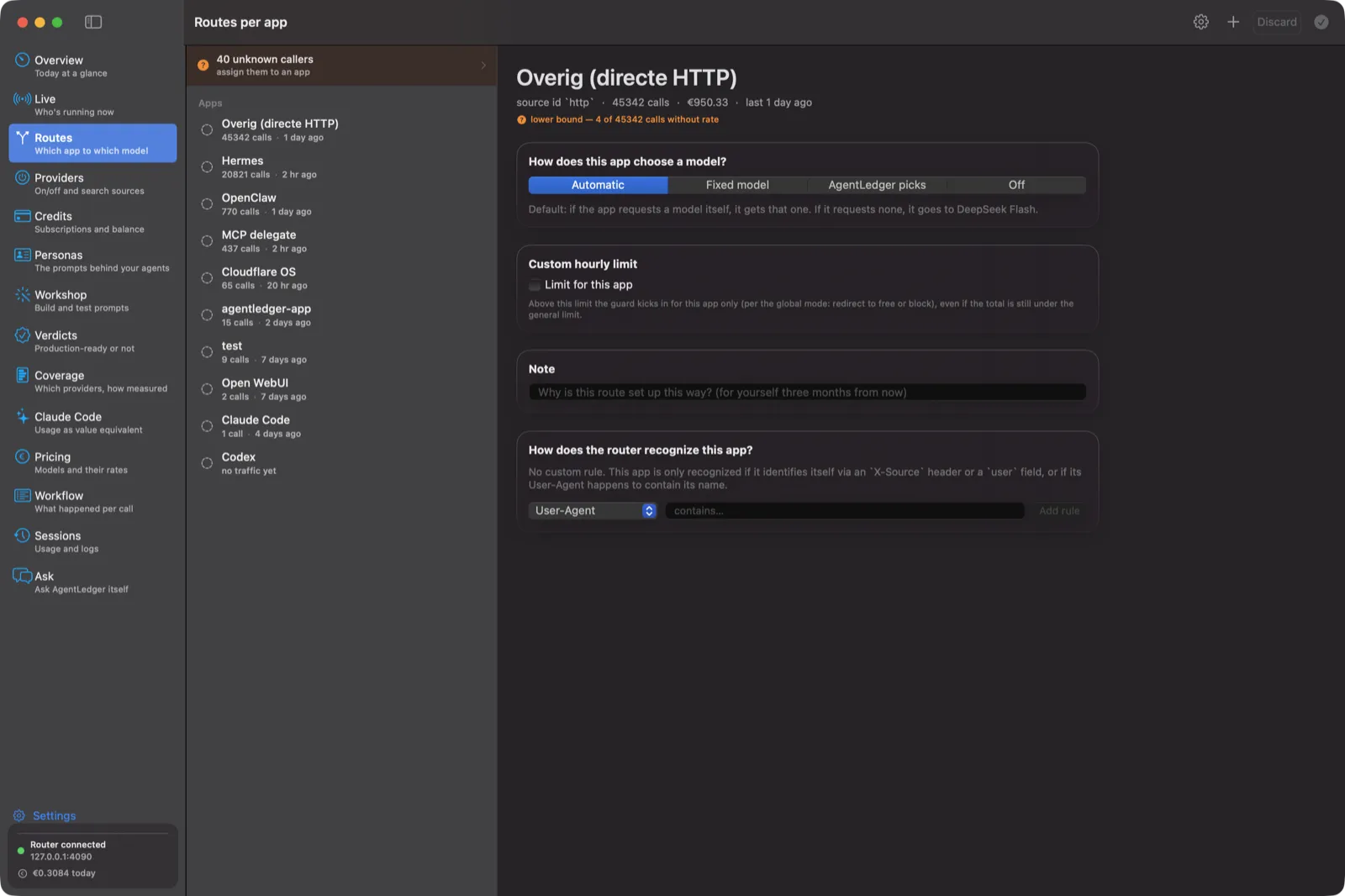
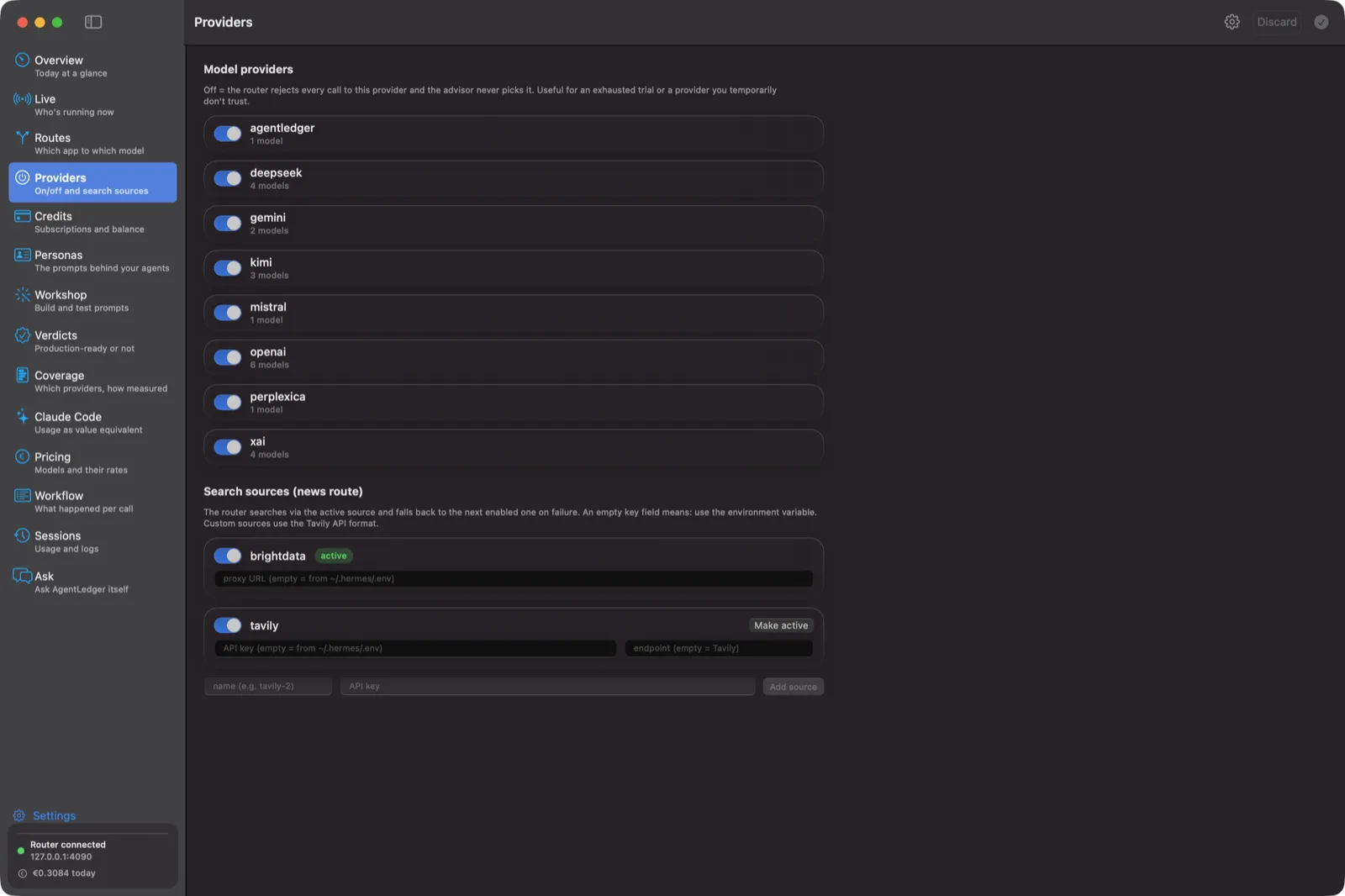
Set per app: automatic, a fixed model, let AgentLedger choose, or off entirely. An empty policy means exactly the old behaviour — you can switch it on without breaking anything.
For every call it is recorded why it went the way it did: which task type was recognised, which route setting applied, where it went, which backend actually executed it, and what that cost.
Every call carries a pricing status: priced, free, subscription, local or unpriced. Unpriced is not a zero but a gap — and any total containing one is shown as a lower bound.
An hourly limit on real spend. Above it, paid calls go to the free model instead of running on. The brake fires on euros, never on subscription value.
Near-identical calls repeating inside a time window are flagged even when they are free — a free loop costs no money but does cost quota and time. Calls that hang are counted separately.
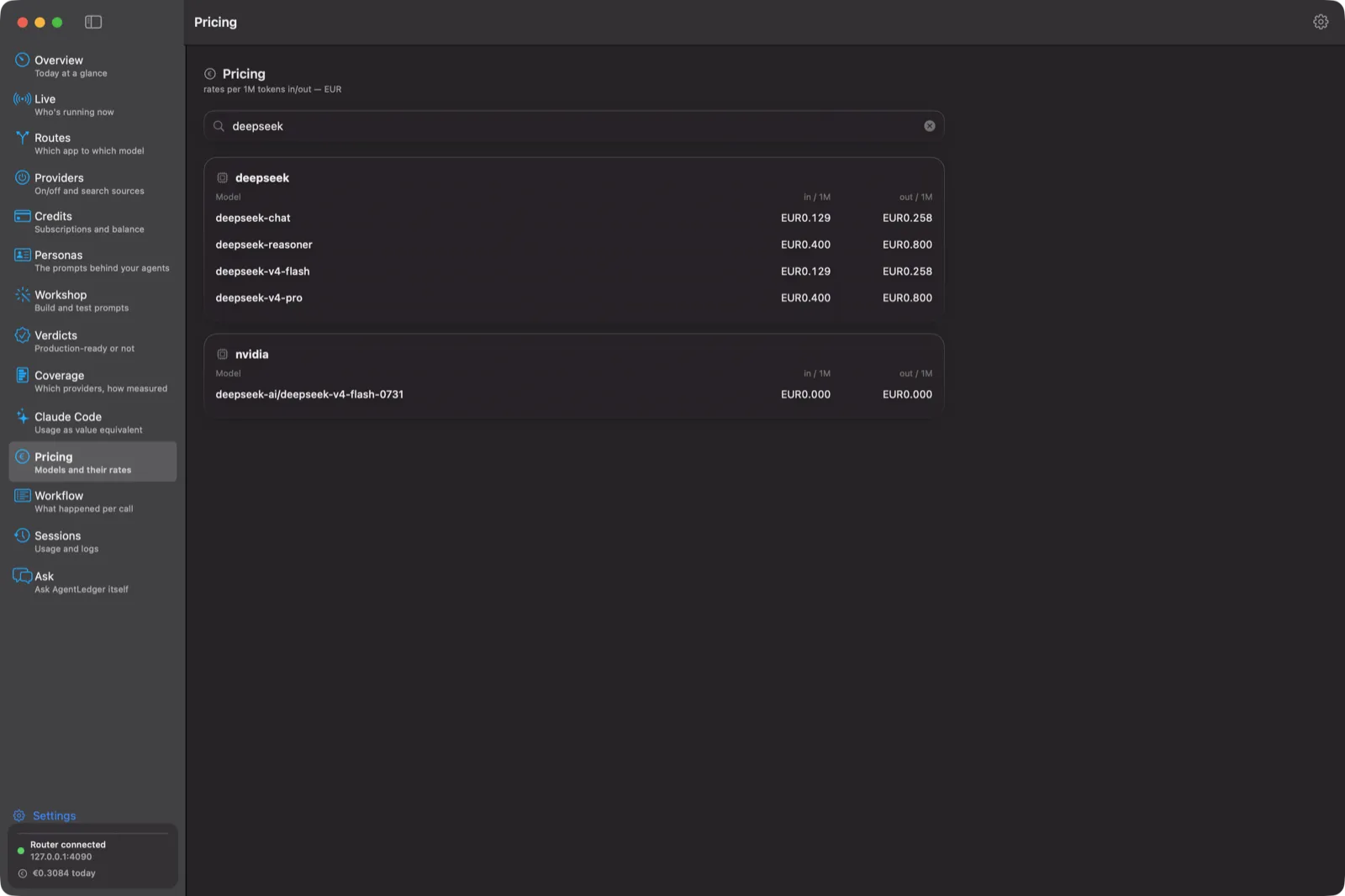
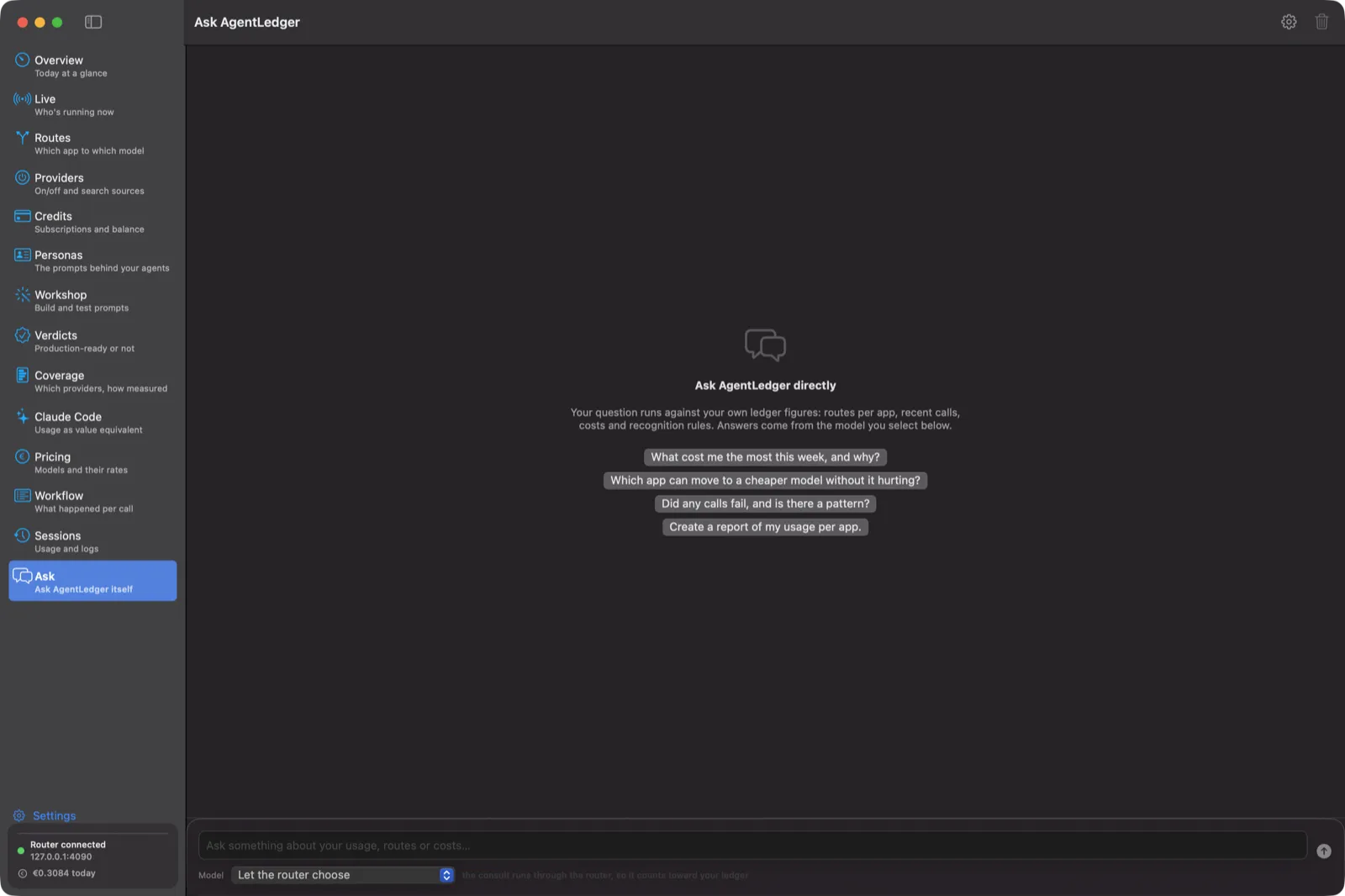
These are screenshots from the native Mac app in English, taken on 19 August 2026 with real production data from our own lab. Nothing was drawn in and nothing polished away — the failed calls and the unpriced gaps are simply there, because that is exactly what the product is about.
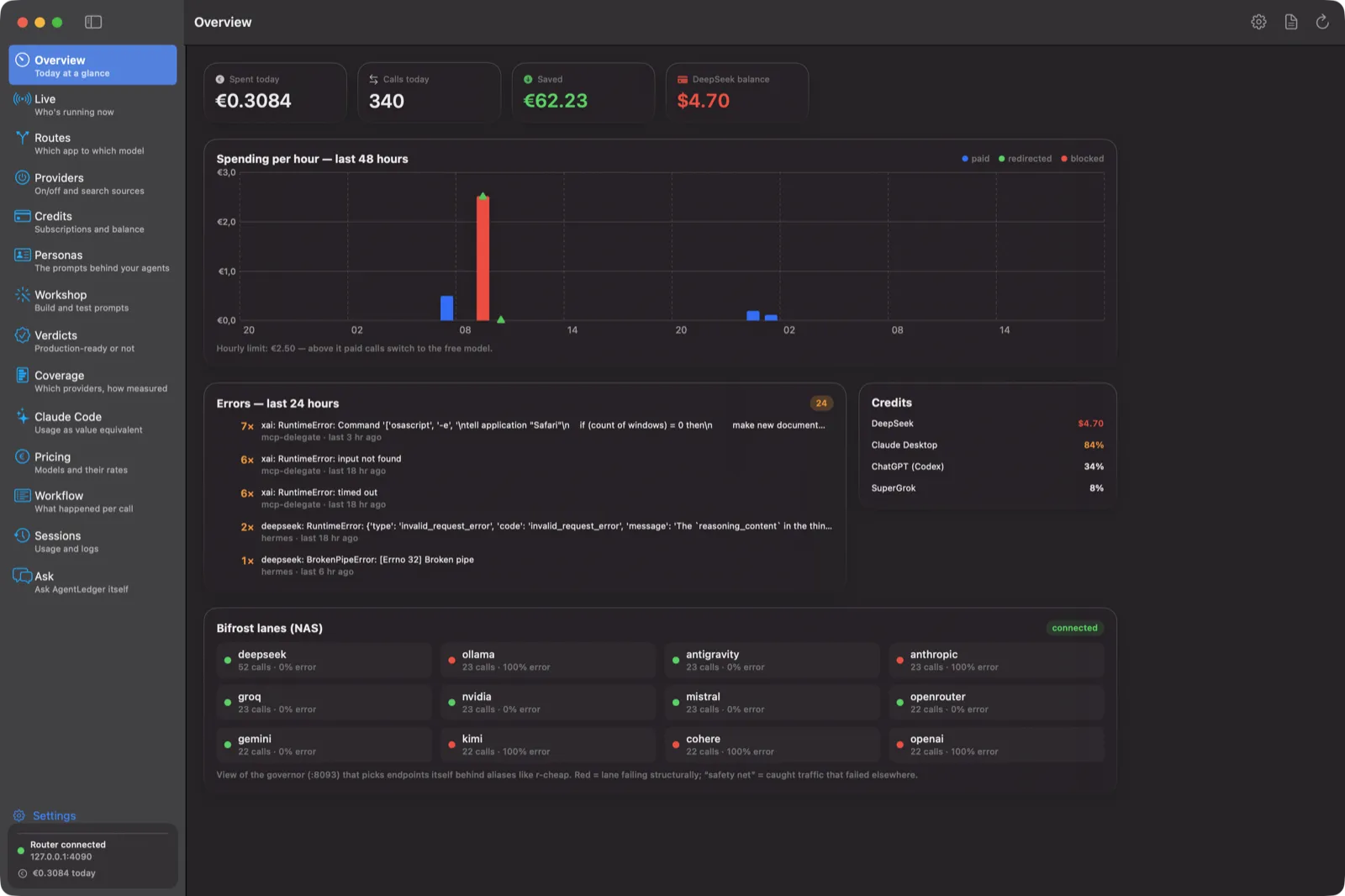
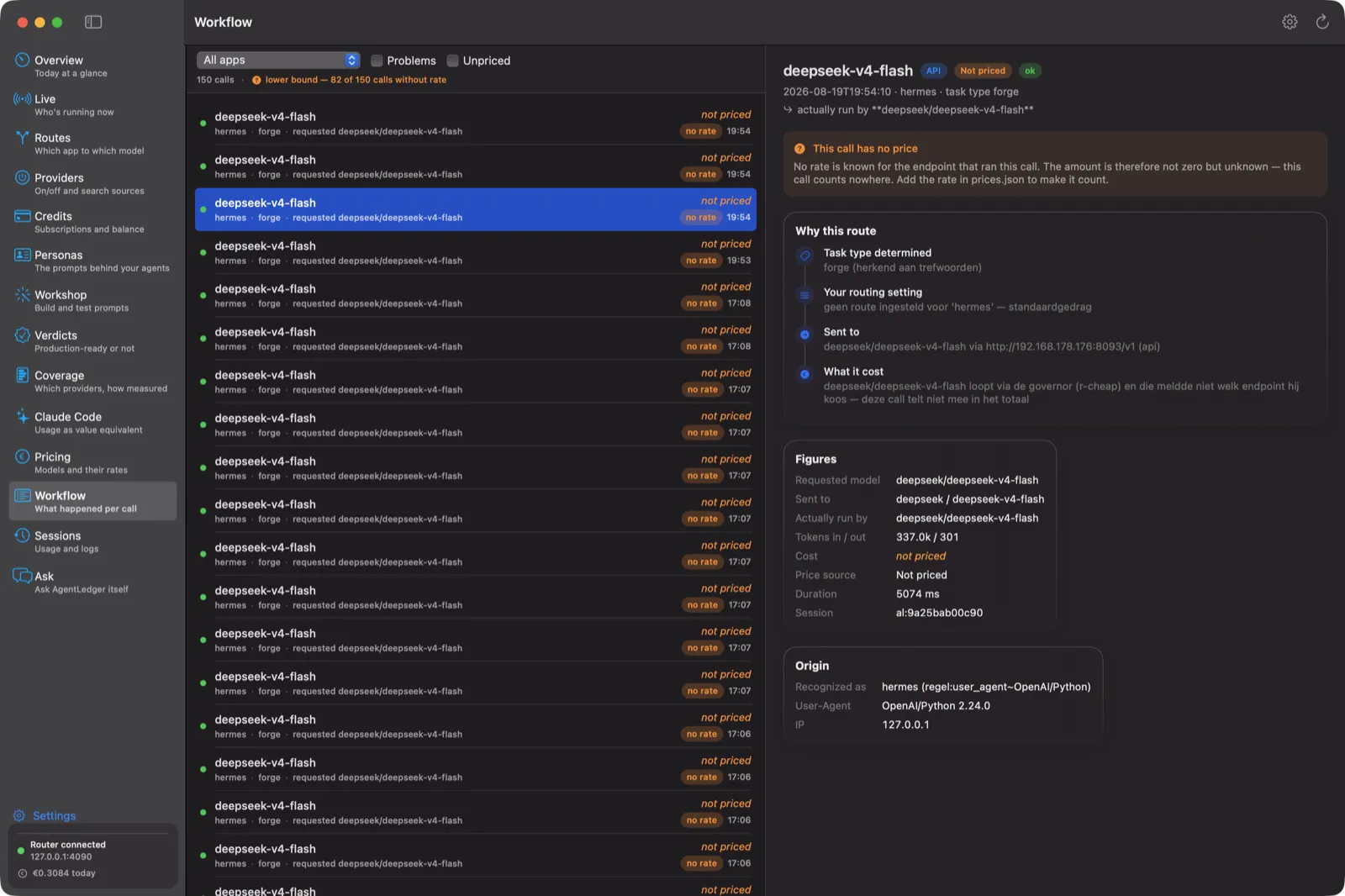
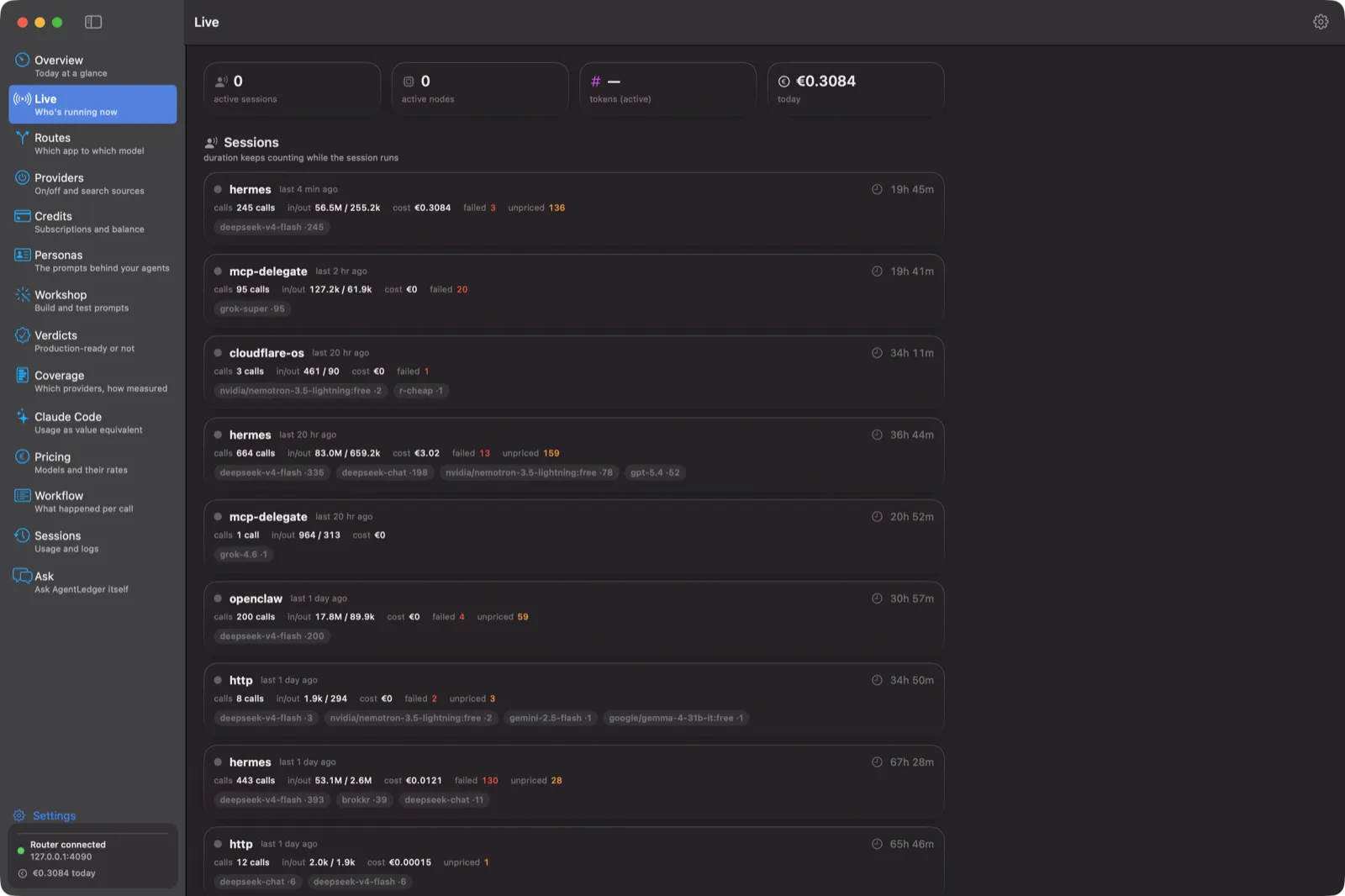
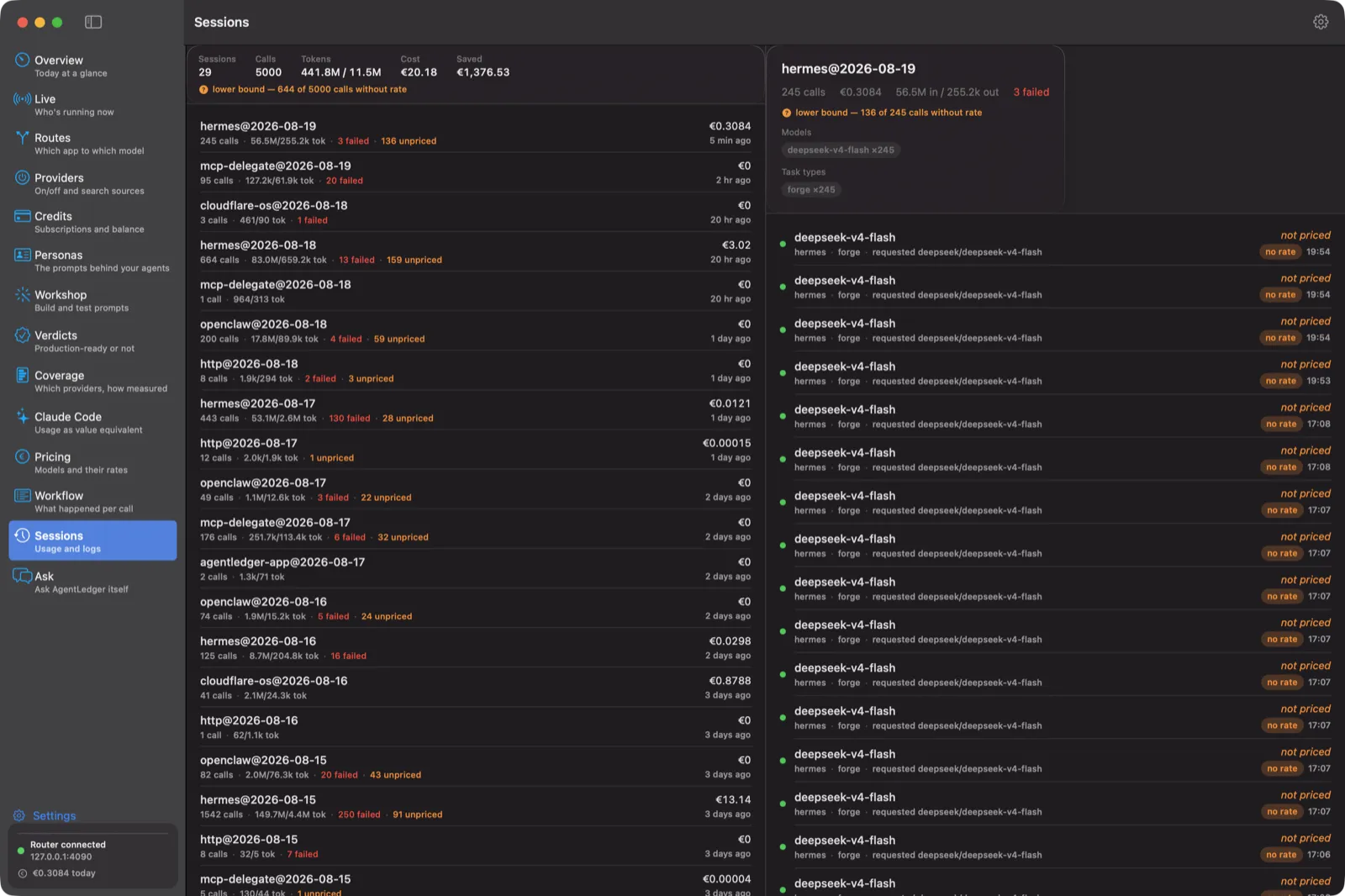
Almost every cost dashboard has the same silent fault: whatever it cannot price, it books as zero. The total then looks healthy and nobody sees that a piece is missing. AgentLedger does it the other way round.
Each of these sat unnoticed for months inside a system that looked healthy. They are here because the correction is the product: these are exactly the places where a cost dashboard lies to you without knowing it.
Every call without a known rate silently got zero euros. On a single day, 14,911 calls sat at € 0.00 against 1.17 billion input tokens. The total was therefore not a cost figure but a lower bound, without anyone being able to see it. Since then “unpriced” is its own status with an empty value instead of a zero.
Of 39,542 logged calls, all 39,542 sat under the source “http”. Every app was one app as far as the router was concerned, so per-app routes had nothing to grip on. Detection now runs in a fixed order — explicit header, own rule, sniffing — and records per call which rule actually fired.
Under heavy concurrent streaming the finalising write failed with “database is locked”, leaving a call stuck in status “routing”. Eighty-three of them, two to fifteen days old. The fix was in the database settings, not the logic — plus a safety net that closes any dangling row anyway. Nothing was deleted; they are marked as aborted.
If the router itself does not report which endpoint it became, the alias rate is an assumption. That assumption either costs tens of euros a day that do not exist, or it hides paid traffic. So pricing follows what the backend actually executed — or nothing at all.
The same correlation thread runs through our workflow automation.
AgentLedger runs in production in our own lab and is in beta. There is deliberately no release date: measurement coverage per provider has to be finished first, because a measuring instrument that papers over its gaps is worse than none at all. Looking along or thinking along is welcome.
Digital Salesperson
Neuralex
You are talking to an AI assistant. Every answer shows its source.
You are talking to an AI assistant of Neuralex — not a human. I answer only from what is on this site, with the source below each answer. If it is not here, I say so.
No legal advice · nothing stored in your browser